

Developing Just and Inclusive Communities
Developing Just and Inclusive Communities
Hans Morten Haugen, Benedicte Tveter Kivle, Tony Addy, Terese Bue Kessel, John Klaasen (eds)
Challenges for Diakonia / Christian Social Practice and Social Work
2022 | 301pp pb | ISBN: 978-1-914454-47-9
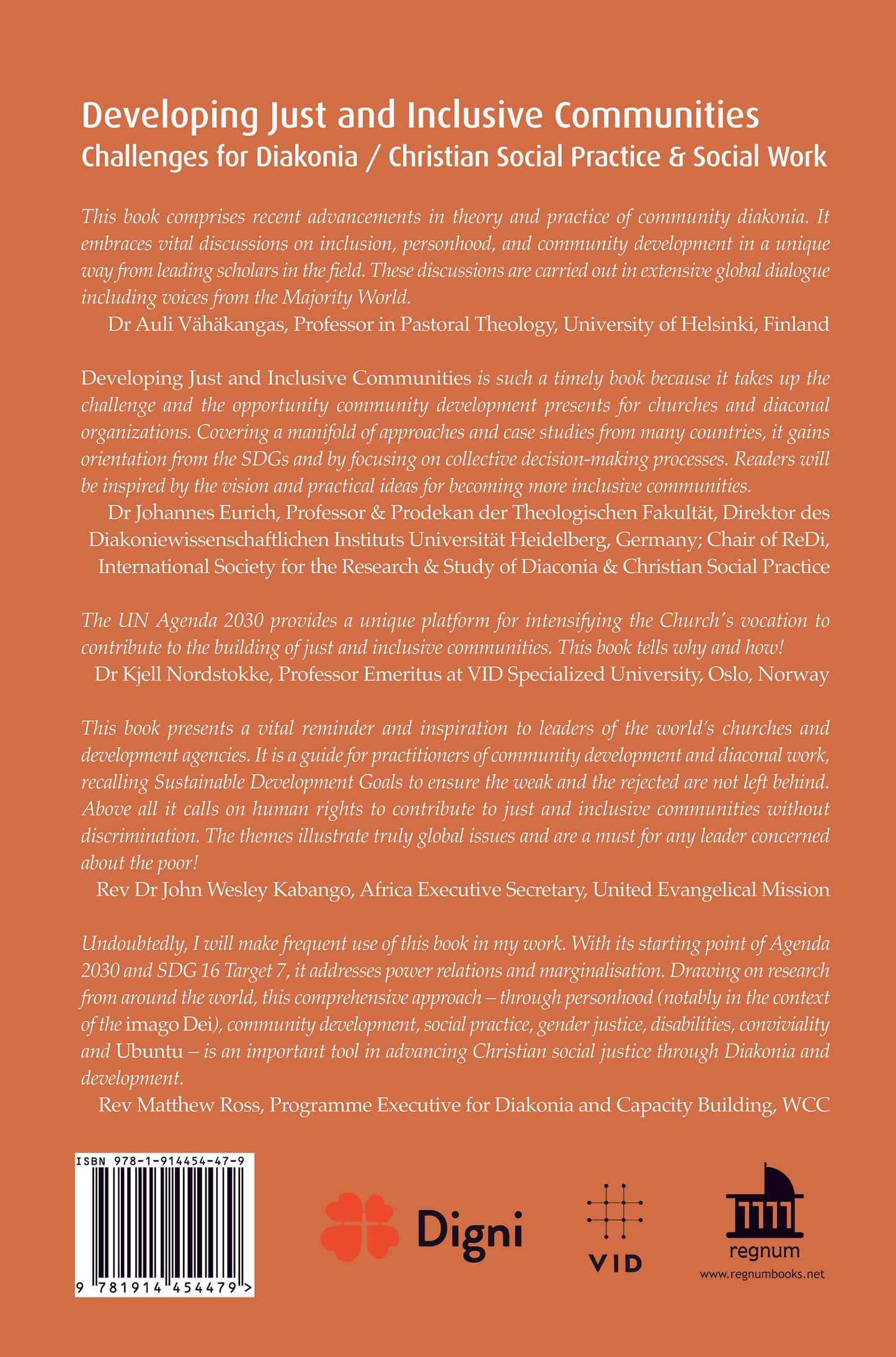
This book comprises recent advancements in theory and practice of community diakonia. It embraces vital discussions on inclusion, personhood, and community development in a unique way from leading scholars in the field. These discussions are carried out in extensive global dialogue including voices from the Majority World.
Dr Auli Vähäkangas, Professor in Pastoral Theology, University of Helsinki, Finland
Developing Just and Inclusive Communities is such a timely book because it takes up the challenge and the opportunity community development presents for churches and diaconal organizations. Covering a manifold of approaches and case studies from many countries, it gains orientation from the SDGs and by focusing on collective decision-making processes. Readers will be inspired by the vision and practical ideas for becoming more inclusive communities.
Dr Johannes Eurich, Professor & Prodekan der Theologischen Fakultät, Direktor des Diakoniewissenschaftlichen Instituts Universität Heidelberg, Germany; Chair of ReDi, International Society for the Research & Study of Diaconia & Christian Social Practice
Table of Contents
Table of Contents
CONTENTS
Foreword
Dr Isabel Apawo Phiri vii
Editors’ Foreword
Hans Morten Haugen, Benedicte Tveter Kivle,
Tony Addy, Terese Bue Kessel and John Klaasen ix
The Roles of Churches and Community Organisations
Hans Morten Haugen, Benedicte Tveter Kivle,
Tony Addy, Terese Bue Kessel and John Klaasen 1
PART ONE: OVERALL APPROACHES
Approaches to Community Development
Tony Addy 15
Personhood and Inclusive Communities: Access to Justice for All
John Klaasen 33
Human Rights as Inclusionary and Empowering Tools
Hans Martin Haugen 49
PART TWO: APPROACHES TO COMMUNITY DEVELOPMENT AND DIAKONIA
A Critical Evaluation of Ubuntu Principle as Just and Inclusive Communities in a Contemporary Africa
Benson Anofuechi 65
‘Seeking Conviviality’ as a Core Concept for Community Development
Tony Addy 79
A Diaconal Approach to Community Development in the Light of the Sustainable Development Goals: ‘Leaving No One Behind’ through Exploring Religious Resources for Creating Just and Inclusive Communities
Stephanie Dietrich 95
PART THREE: SOCIAL PRACTICE AND DIAKONIA
In What Ways Can the Church Function as a Generator for Inclusive and Sustainable Communities? A Case Study on What Role the Local Congregation Plays in Two Different Urban Communities
Silje K. Andreassen and Kjersti G. Norheim 113
Lifezone Sport International: A Narrative of Diaconia Viewed through the Lens of Tangible Hope
Jeremy Wyngaard 127
Contemporary Mizuko Ritual in Japan for Aborted Children: A Proposal to Pastoral Counselling in the Christian Church
Terese Bue Kessel 143
Parenting Strategies to Prevent Risks for Adolescents in Urban Neighbourhoods
Silje Hole Hirsch 157
PART FOUR: LEARNING, SOCIAL INNOVATION AND LEADERSHIP
Ministerial Formation of Former ‘Mission Churches’ in South Africa: ‘Missional Consciousness’ as an Enabler for Community Development
Eugene Baron 175
Faith-based Organisations and Social Innovation for Just and Inclusive Communities? A Scoping Review
Dag Håkon Eriksen and Annette Leis-Peters 189
Leading towards Inclusion in Communities – Unity and Diversity when Leading towards Inclusiveness
Benedicte Tveter Kivle and Beate Jelstad Løvaas 215
PART FIVE: SOCIAL INCLUSION, GENDER, DISABILITY AND DIVERSITY
Ruth the Moabite: A Story about an Immigrant and Her Struggle for Identity
Tiana Bosman 233
Gender Responsive Organisations and the 2030 Agenda
Marit Breen 247
The Use of Asset-Based Approach as a Tool for the Inclusion of Persons with Disabilities: Case Study of HANDICARE in Ngaoundéré – Cameroon
Amos Ounsoubo 261
Developing Just and Inclusive Communities
Tony Addy, John Klaasen, Terese Bue Kessel,
Benedicte Tveter Kivle and Hans Morten Haugen 277
Contributors 283
Index 289
About the Author
About the Author
ABOUT THE EDITORS:
Hans Morten Haugen, has doctoral degrees in Law and in Political Science, and works as Professor of International Diakonia at VID Specialized University, Oslo, Norway. He has written extensively on inclusive development; human rights and international economic law; and the role of the churches in the political realm.
Terese Bue Kessel, has a doctoral degree in practical theology and works as Associate Professor and Head of the Department of Theology at VID Specialized University, Stavanger, Norway. She has written on empowerment processes of women and pastoral counselling in cross-cultural contexts; and faith-education.
Tony Addy is involved in teaching, research and writing in the field of church and community development. He is a consultant to the Lutheran World Federation and has an expert position on community development and diakonia at the VID Specialized University, Oslo, Norway.
Benedicte Kivle is an Associate Professor in Values-based Leadership at VID Specialized University, Oslo, Norway. She leads the Master in Community Development and Social Innovation in the same institution. Kivle holds a PhD in Sociology and has published research on health management, learning in organizations, trust-based leadership and participatory research.
Prof. John Klaasen lectures in Practical Theology at The University of the Western Cape and is currently serving a second term as Head of the Department of Religion and Theology. He is also visiting Professor at VID Specialized University. He is an ordained Anglican minister and holds the office of The Dean of Studies and Canon Theologian.
QUESTIONS TO THE EDITORS ABOUT THE BOOK:
1. Why did you decide to write your book?
We experience that the sustainable development goals (SDGs)/Agenda 2030 cause both inspiration and frustration for our students and others we encounter. The holistic approach, both thematically and in establishing a global development agenda is inspiring. These links up to a thinking found in churches, church-related development organisation and others. The gap between words used and the realities on the ground is often frustrating. We experience that students and others need concrete experiences and stories, to give life and meaning to the SDGs/2030 Agenda
2. What is distinctive about content of your book?
We chose one SDG target, namely 16.7, which is exactly about just and inclusive communities. The various chapters all relate to this in implicit and explicit ways. What is not widely known is that the World Council of Churches already in the 1970s promoted awareness on just, participatory and sustainable communities. This book seek in various ways to elaborate on what hinders and what promotes such communities, by a bottom-up and power-critiquing perspective.
3. Why is this subject important?
Starting with the churches, they play in many parts of the world crucial roles in upholding communities. Some churches are, however, not willing to engage in processes involving too explicit criticism of the political leaders and their inadequate or misguided policies. Being too close to secular power always implies a risk of not being adequately attentive to and able to counter various forms of exclusions of persons from important decision-making processes. If churches themselves are engaged in exclusionary practices they will not be able to bear a strong witness of transformation. Regarding social work organisations, the awareness of societal problems that might require new alliances and possible cooperation with churches or church-based organisations might also serve as an inspiration.
4. What difference would this book make for the ministry?
The book has chapters analysing processes at various levels of a church or church-based actor, from the national to the congregational, and also engages with transforming human beings. All persons serving in a church should acknowledge their unique calling to mirror God’s love and Jesus’ incomprehensible sacrifice that makes us all free to serve our neighbours. Any church servant, paid or non-paid should ask themselves how I can contribute, and possibly also seek new forms of cooperation across denominational or religious-secular divides.
5. Feel free to add anything else you find relevant.
This book is not only relevant for church-affiliated persons. The book is as relevant for persons without a clear affiliation to a church who want to learn more about community thinking and practice.
Endorsements
Endorsements
This book comprises recent advancements in theory and practice of community diakonia. It embraces vital discussions on inclusion, personhood, and community development in a unique way from leading scholars in the field. These discussions are carried out in extensive global dialogue including voices from the Majority World.
Dr Auli Vähäkangas, Professor in Pastoral Theology, University of Helsinki, Finland
Developing Just and Inclusive Communities is such a timely book because it takes up the challenge and the opportunity community development presents for churches and diaconal organizations. Covering a manifold of approaches and case studies from many countries, it gains orientation from the SDGs and by focusing on collective decision-making processes. Readers will be inspired by the vision and practical ideas for becoming more inclusive communities.
Dr Johannes Eurich, Professor & Prodekan der Theologischen Fakultät, Direktor des Diakoniewissenschaftlichen Instituts Universität Heidelberg, Germany; Chair of ReDi, International Society for the Research & Study of Diaconia & Christian Social Practice
The UN Agenda 2030 provides a unique platform for intensifying the Church's vocation to contribute to the building of just and inclusive communities. This book tells why and how!
Dr Kjell Nordstokke, Professor Emeritus at VID Specialized University, Oslo, Norway
This book presents a vital reminder and inspiration to leaders of the world’s churches and development agencies. It is a guide for practitioners of community development and diaconal work, recalling Sustainable Development Goals to ensure the weak and the rejected are not left behind. Above all it calls on human rights to contribute to just and inclusive communities without
discrimination. The themes illustrate truly global issues and are a must for any leader concerned about the poor!
Rev Dr John Wesley Kabango, Africa Executive Secretary, United Evangelical Mission
Undoubtedly, I will make frequent use of this book in my work. With its starting point of Agenda 2030 and SDG 16 Target 7, it addresses power relations and marginalisation. Drawing on research from around the world, this comprehensive approach – through personhood (notably in the context of the imago Dei), community development, social practice, gender justice, disabilities, conviviality and Ubuntu – is an important tool in advancing Christian social justice through Diakonia and
development.
Rev Matthew Ross, Programme Executive for Diakonia and Capacity Building, WCC
Additional Resources and Book Reviews
Additional Resources and Book Reviews
Share